
Sustainability · 2025
In this section49 topics
- Sustainability Policy2 items
- Sustainability Goals & UN SDGs3 items
- Policy Review3 items
- Business Value Chain1 item
- Stakeholder Analysis1 item
- Environmental Policy & Guidelines3 items
- Environmental Policy Review1 item
- Energy — Plan & Guidelines2 items
- Energy — Electricity Consumption1 item
- Energy — Fuel Consumption1 item
- Energy — Targets2 items
- Energy — Performance & Outcomes2 items
- Water — Plan & Guidelines2 items
- Water — Withdrawal, Discharge & Consumption1 item
- Water — Targets2 items
- Water — Performance & Outcomes2 items
- Waste — Plan & Guidelines2 items
- Waste — Generation, Disposal & Recycling1 item
- Waste — Targets2 items
- Waste — Performance & Outcomes2 items
- GHG — Plan & Guidelines2 items
- GHG — Emissions1 item
- GHG — Emissions Verification2 items
- GHG — Principles & Standards1 item
- GHG — Targets1 item
- GHG Targets — Other Targets1 item
- GHG — Performance & Outcomes2 items
- Environmental Legal Incidents1 item
- Social Sustainability — Overview1 item
- Social Policy & Guidelines3 items
- Social Policy Review3 items
- Human Rights Due Diligence2 items
- Employees — Plan & Guidelines3 items
- Employees — Workforce1 item
- Employees — Remuneration & Provident Fund1 item
- Employees — Training & Development1 item
- Employees — Occupational Health & Safety1 item
- Employees — Labour Relations1 item
- Employees — Employee Representation2 items
- Employees — Targets2 items
- Employees — Performance & Outcomes2 items
- Customers — Plan & Guidelines3 items
- Customers — Satisfaction Results1 item
- Customers — Targets2 items
- Customers — Performance & Outcomes2 items
- Community & Social — Plan & Guidelines3 items
- Community & Social — Targets2 items
- Community & Social — Performance & Outcomes2 items
- Law Violation Incidents1 item
Sustainability Policy
Has a Sustainability Policy
Yes
Policy Description
Sustainability Development Plan and Implementation
Recognizing the importance of sustainable business practices as a fundamental pillar for long-term stable growth, the Company has continuously integrated ESG (Environmental, Social, and Governance) principles into its core operations. The Company remains committed to and compliant with its comprehensive sustainability policy across all dimensions.
In the fourth quarter, the Company successfully passed audits covering labor standards, occupational health and safety, business ethics, and environmental management in accordance with the Disney International Labor Standards (Disney ILS). This achievement affirms the Company’s readiness and consistency in sustainability management and provides assurance to customers producing licensed Disney products that the Company operates in full compliance with standards established by The Walt Disney Company.
In addition, the Company remains committed to continuously collecting data and calculating its organizational carbon footprint across all three scopes: Direct GHG Emissions, Indirect GHG Emissions from Imported Energy, and Other Indirect GHG Emissions, in accordance with the requirements of Thailand Greenhouse Gas Management Organization (TGO).
The preliminary data (covering January 2025 – November 2025) was verified on 22 December 2025 by BSI Group (Thailand) Co., Ltd.. The Company will proceed with verification of the complete dataset to obtain official certification from TGO in January 2026.
1. Announcement No. 07/2023 Sustainable Business Policy (Sustainable Organization) Setting the framework for sustainability development in the following areas:
• Social responsibility.
• Responsibility for employees, occupational health, safety, and the working environment.
• Environmental responsibility and management.
• Good governance and conducting business with fairness.
• Adhering to business ethics.
• Promoting and cultivating organizational culture.
2. Announcement No. 30/2023 Sustainable Procurement Policy Setting the framework for sustainability development in the following areas:
• Transparent, fair, and verifiable procurement.
• Strict and full compliance with laws related to procurement.
• Treating all trading partners fairly, equitably, and without discrimination.
• Selection of partners who prioritize reducing environmental and social impacts and operate with good governance.
• Compliance with the Anti-Corruption Policy
• Having partners report any non-transparent actions or conflicts of interest arising from the conduct of employees of
Salee Printing Public Company Limited.
3. Announcement No. 18/2024 Labor and Sustainable Labor Management Policy Setting the framework for sustainability development in the following areas:
• Prohibition of child labor.
• Prohibition of forced labor.
• Respecting diversity and treating employees equally without discrimination.
• Granting the right to freedom of association and collective bargaining.
• Promoting a good working environment and the quality of life of workers.
• Compliance with laws and regulations regarding working hours and holidays.
• No disciplinary action by way of fines, wage deductions, or physical and mental abuse.
• Giving importance to pregnant women.
• Not supporting any form of human trafficking.
• Supporting the rehabilitation and reintegration of victims of child labor, forced labor, and human trafficking.
• Encouraging and supporting labor contractors, subcontractors, suppliers, and business partners to comply with labor,
social, and human rights standards.
• Ensuring communication of labor and sustainable management policies to both internal and external stakeholders
through various channels.
• Opening channels for complaints or whistleblowing through various channels when witnessing actions believed to
violate established policies or practices, with protection for whistleblowers and confidentiality of information.
Sustainability Goals & UN SDGs
Has Sustainability Goals
Yes
Goals Description
The various sustainability policies set by the company have been used to develop sustainability management goals in various areas in 2025, as follows:
1. Environmental Goals
Energy Efficiency: Reduce total electricity consumption by 1% compared to the 2024 base year.
Water Conservation: Reduce total water consumption by 10% compared to the 2024 base year.
Waste Recycling & Reutilization: Increase the waste recycling and reuse rate by 1% compared to the 2024 base year.
Waste Reduction: Reduce total waste generation by 1% compared to the 2024 base year.
2. Labor Goals
Translation (English):
In 2025, the Company conducted training and development programs to enhance employees’ skills and knowledge. All employees were required to receive at least 15 hours of training per year. The training covered a wide range of topics, including production techniques, quality control, machine maintenance, sustainability development, workplace safety, climate change, and other relevant subjects. As a result, 100% of employees completed the required 15 training hours.
The Company also complies with labor standards, occupational health and safety requirements, and workplace environmental regulations. Compliance is measured through assessments under the SMETA (Sedex Members Ethical Trade Audit) and EcoVadis audit frameworks, for which the Company undergoes annual evaluations to review and ensure the effectiveness of its management systems.
In addition, the Company regularly monitors and reviews its occupational safety management system and provides training to employees on the prevention of work-related illnesses. Safety awareness activities are also organized for all employees, particularly in high-risk areas, to promote greater awareness of workplace safety. These initiatives aim to help employees recognize potential risks in their work processes and understand appropriate measures to prevent accidents that may occur.
3. Ethical Goals
• Comply with business ethics standards, as measured by external audit results in accordance with the Sedex Members Ethical Trade Audit (SMETA) methodology.
UN Sustainable Development Goals
| SDG Goal |
|---|
| Goal 3 Good Health and Well-being |
| Goal 3 Good Health and Well-being |
| Goal 4 Quality Education |
| Goal 4 Quality Education |
| Goal 7 Affordable and Clean Energy |
| Goal 7 Affordable and Clean Energy |
| Goal 12 Responsible Consumption and Production |
| Goal 12 Responsible Consumption and Production |
| Goal 13 Climate Action |
| Goal 13 Climate Action |
Policy Review
Policy Reviewed This Year
Yes
Policy Changed This Year
Yes
Review Details
All targets are reviewed against the 2025 base year, with new objectives established to ensure continuous improvement across the dimensions of Environment, Labor, and Business Ethics.
Business Value Chain
Value Chain Description
Managing the impact on stakeholders in the business value chain is crucial to creating sustainability and long-term success. Businesses that care for and value all stakeholders will gain acceptance and trust, which positively impacts the organization's image and performance. It consists of
1. Internal stakeholders
1.1 Employees Committed to developing the organization into a learning organization, strengthening the culture, and working atmosphere, promoting teamwork, providing fair compensation, taking care of safety, and preserving the working environment. Giving importance to the development, knowledge transfer, and abilities of employees. Listening to comments and suggestions from employees at all levels equally and fairly. Establishing and building on the cultivation of organizational culture. Realizing that every employee is an important factor and valuable, leading to the company's success, progress, and sustainable growth.
2. External stakeholders
2.1 Shareholders
2.2 Customers
2.3 Partners
2.4 Creditors
2.5 Government or state officials
2.6 Competitors
2.7 Community, Society, Public and Environment
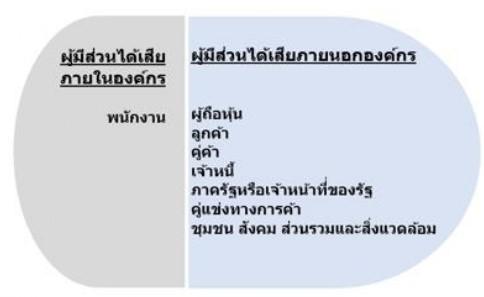
Stakeholder Structure and Segmentation
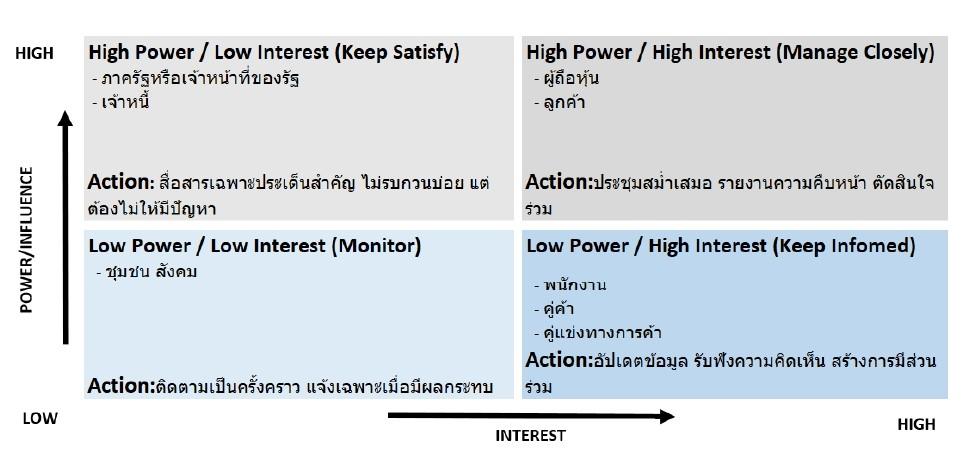
Stakeholder Analysis
Stakeholder Analysis
| Stakeholder Type | Stakeholders | Stakeholder Expectations | Response to Expectations | Communication Activities |
|---|---|---|---|---|
| Internal stakeholders | 2921 · Description: Employees | 1. Job Security and Career Stability
2. Compensation and Benefits, Appropriate Benefits
3. Development and Training
4. Equality, Acceptance, and Fairness
5. Workplace Safety | 1. Communicate to employees about the company's business direction, performance, career growth policies, and fair performance evaluations.
2. Adjust the salary and compensation structure to be competitive with the labor market.
3. Promote learning, essential skills, and new skills development.
4. Ensure equal treatment, non-discrimination, and employee participation.
5. Regularly maintain the work environment and provide safety equipment. | 2941 · Description: Online Communication · 2942 · Description: Internal Meeting · 2945 · Description: Complaint Reception · 2947 · Description: Satisfaction Survey · 2948 · Description: Training / Seminar |
| External stakeholders | 2894 · Description: Creditor · 2899 · Description: Suppliers · 2913 · Description: Shareholders · 2923 · Description: Customers · 2928 · Description: Society · 2931 · Description: Government agencies and Regulators | 1. Payment received on time.
2. Strict adherence to contract terms.
3. Transparent and verifiable financial information.
4. Good and consistent communication.
5. Development of long-term partnerships.
6. Receipt of high-quality and safe products/services.
7. Efficient and prompt service.
8. Accurate and complete information provided.
9. Fair treatment in the purchase of goods/services.
10. Business operations conducted with social, community, and environmental responsibility.
11. Support for community and social development activities.
12. Compliance with laws and regulations.
13. Proper tax payments. | 1. Manage cash flow effectively.
2. Prepare accurate and timely financial reports.
3. Build fair and good relationships.
4. Comply with contracts and agreements.
5. Promote the development of partners' potential.
6. Develop quality and safe products/services.
7. Improve service to be fast and efficient.
8. Listen and solve customer problems.
9. Conduct business ethically and give back to society and the community.
10. Reduce environmental impact.
11. Support activities for society, community, and the environment.
12. Comply with laws and cooperate with government agencies.
13. Pay taxes correctly and in full. | 2938 · Description: Visit · 2940 · Description: Social Event · 2941 · Description: Online Communication · 2942 · Description: Internal Meeting · 2943 · Description: External Meeting · 2948 · Description: Training / Seminar |
Environmental Policy & Guidelines
Has an Environmental Policy
Yes
Policy Description
Salee Printing Public Company Limited has established an environmental policy as announced in Announcement No. 09/2022 and reviews the policy annually. From 2023 - 2025, the review concluded that the policy remains appropriate and relevant to the current situation. The policy outlines the following framework as below:
1. Compliance with Environmental Laws and Other Relevant Regulations, such as Customer Requirements and Local Authority Regulations
Environmental Law Management Practices: The company updates environmental laws and regulations monthly, assesses their relevance to the company, and evaluates the alignment of current practices. If any discrepancies are found, action plans are developed and implemented to ensure compliance, with monthly progress monitoring.
2. Preventing Pollution Problems and Reducing Environmental Impacts
Waste and Waste Management Practices: Establish waste and waste management regulations, define waste sorting criteria, and monitor waste collection points in each area. Establish procedures for evaluating and monitoring the performance of waste disposal contractors. Define regulations for waste generated by contractors to ensure that waste management related to company activities complies with legal requirements. Maximize the amount of waste that can be recycled to conserve natural resources. Non-recyclable waste is disposed in the form of SRF (Solid Recovered Fuel), which involves upgrading the waste quality through a process of shredding and sorting to create high-quality fossil fuel substitutes for use in cement plants and thermal power generation. Other remaining waste is separated for reuse by the disposal contractor. Currently, the company's production waste is considered Zero Landfill.
Air Quality Management Practices: Conduct annual inspections as required by law and install additional production exhaust filtration systems to enhance air pollution control. Recent inspection results indicate that the company's air pollution levels are significantly lower than the legal limits, ensuring the safety of employees and the surrounding community.
Noise Pollution Management Practices: Conduct annual noise level measurements as required by law, both in employee work areas and noise affecting the surrounding community. The measured values are found to be below the legal limits.
Greenhouse Gas and Climate Change Management Practices: Conduct training for employees to raise awareness about the impacts of greenhouse gases. Obtain a Carbon Footprint for Organization (CFO) certification to identify significant greenhouse gas emission sources, leading to the development of plans to reduce greenhouse gas emissions from company activities.
3. Environmental Protection by Promoting the Conservation of Resources, Including Efficient Energy Use
Electricity Management Practices: Implement and consistently enforce energy-saving measures such as turning off lights, air conditioners, and computer screens when not in use. Implement appropriate additional measures based on the situation each year.
il and Fuel Management Practices: Set appropriate oil and fuel expense limits based on needs and track oil and fuel consumption monthly to observe trends in oil and fuel usage each month.
Renewable/Clean Energy Management Practices: The company continuously explores the adoption of clean/renewable energy. Currently, solar cells have been installed on the roofs of all company buildings, and monthly electricity generated from the solar cells is monitored to assess the system's efficiency.
Water Resources and Water Quality Management Practices: Regular inspections of meters, water pipes, and valves are required. Monthly water consumption is monitored to observe trends in water usage each month. Water quality inspections are conducted regularly to ensure that the water used is of good quality and suitable for use by employees and the company.
4. Continuous Improvement of Environmental Management System Operations
Continuous Improvement Practices: Encourage employee participation in waste sorting and promote the exploration and implementation of new approaches to conserve natural resources and energy.
The implementation of this policy is a core management objective and a shared responsibility of all employees working on behalf of the Company. Furthermore, this policy has been communicated to our business partners for their awareness and compliance. The Company is committed to disclosing this environmental policy to all stakeholders for public acknowledgement.
Environmental Guidelines
| Guideline |
|---|
| Electricity Management |
| Fuel Management |
| Renewable/Clean Energy Management |
| Water Management |
| Waste Management |
| Greenhouse Gas and Climate Change Management |
| Air Quality Management |
| Noise Pollution Management |
Environmental Policy Review
Policy Reviewed This Year
Yes
Energy — Plan & Guidelines
Has an Energy Management Plan
Yes
Plan Description
The company has an energy management plan for 2025 to maintain compliance with energy-saving measures and maximize the efficiency of Solar Cell usage, as well as to ensure energy management in accordance with legal requirements, which includes:
Establishing an energy management working group
Conducting a preliminary energy management assessment
Establishing an energy conservation policy and periodically reviewing the policy
Assessing energy conservation potential
Setting energy conservation targets and plans, training plans, and energy conservation promotion activities
Implementing energy conservation plans, and monitoring and analyzing compliance with energy conservation targets and plans
Monitoring and evaluating energy management
Reviewing, analyzing, and correcting energy management deficiencies
Energy — Electricity Consumption
Electricity Consumption
| Metric | Current Year | Previous Year | Two Years Ago |
|---|---|---|---|
| Total electricity consumption within the organization (Kilowatt-Hours) | 5,732,301 | 5,287,412 | 5,200,032 |
| Electricity purchased for consumption from non-renewable energy sources (Kilowatt-Hours) | 4,861,055 | 4,462,900 | 4,955,550 |
| Electricity purchased or generated for consumption from renewable energy sources (Kilowatt-Hours) | 871,246 | 824,512 | 244,482 |
Energy — Fuel Consumption
Fuel Consumption
| Metric | Current Year | Previous Year | Two Years Ago |
|---|---|---|---|
| Crude oil (Barrels) | |||
| Coal (Metric tonnes) | |||
| Jet fuel (Litres) | |||
| Diesel (Litres) | 21,794.63 | 21,437.32 | 37,992.44 |
| Gasoline (Litres) | 11,347.04 | 10,425.68 | 46,020.88 |
| Fuel oil (Litres) | |||
| Natural gas (Standard cubic feet) | |||
| LPG (Kilograms) | 15 | 30 | 0 |
| Steam (Metric tonnes) |
Energy — Targets
Has Set Targets
Yes
Targets
| Target | Base Year | Base Year Value | Target Year | Target Year Value | Target Change (%) | Unit |
|---|---|---|---|---|---|---|
| Reduction of electricity purchased for consumption | 2,024 | 4,462,900 | 2,025 | 44,629 | 1 | Kilowatt-hour |
| Increase of electricity consumption from renewable energy sources | 2,024 | 824,512 | 2,025 | 41,225.6 | 5 | Kilowatt-hour |
Energy — Performance & Outcomes
Has Performance Results
Yes
Performance Description
The operational results and energy management outcomes in 2025 can be summarized as follows:
Reduce electricity purchases in 2025: The total electricity consumption has increased compared to the base year (2024). This is primarily driven by a rise in purchase orders for products requiring multi-stage manufacturing processes, resulting in higher electricity usage proportional to the increased production capacity.
Increased electricity consumption from renewable energy in 2025: Increased by 5.67% or 46,734.00 kilowatt-hours compared to the base year.
Continuously implement the prescribed energy conservation measures.
Water — Plan & Guidelines
Has a Water Management Plan
Yes
Plan Description
The company regularly inspects water meters, pipelines, and valves for leaks. We also monitor daily water consumption by recording water meter readings. This allows us to quickly identify any abnormal water usage and promptly implement corrective actions.
Water — Withdrawal, Discharge & Consumption
Water Withdrawal, Discharge & Consumption
| Metric | Current Year | Previous Year | Two Years Ago | Remark |
|---|---|---|---|---|
| Total water withdrawal (Cubic meters) | 3,662 | 4,409.7 | 5,663 | |
| Total water withdrawal by third-party water (Cubic meters) | ||||
| Total water withdrawal by surface water (Cubic meters) | ||||
| Total water withdrawal by groundwater (Cubic meters) | 3,662 | 4,409.7 | 5,663 | |
| Total water withdrawal by seawater (Cubic meters) | ||||
| Total water withdrawal by produced water (Cubic meters) | ||||
| Percentage of wastewater treated before discharge (%) | 100 | 100 | 100 | |
| Total water discharge (Cubic meters) | 168 | 164.4 | 196.4 | |
| Total water discharge to third-party water (Cubic meters) | 0 | 0 | 0 | |
| Total water discharge to surface water (Cubic meters) | 0 | 0 | 0 | |
| Total water discharge to groundwater (Cubic meters) | 168 | 164.4 | 196.4 | The reported wastewater volume represents the amount generated from production processes requiring treatment. Water used for general utilities flows into a septic tank, making measurement impractical. Discharging treated wastewater that meets regulatory standards into groundwater sources refers to its utilization for watering plants within the company premises or for cleaning buildings and facilities. |
| Total water discharge to seawater (Cubic meters) | ||||
| Total water consumption (Cubic meters) | 3,494 | 4,245.3 | 5,466.6 | |
| Recycled water (Cubic meters) | 168 | 164.4 | 196.4 |
Water — Targets
Has Set Targets
Yes
Targets
| Target | Base Year | Base Year Value | Target Year | Target Year Value | Target Change (%) | Unit |
|---|---|---|---|---|---|---|
| Reduction of water withdrawal | 2,024 | 4,409.7 | 2,025 | 440.97 | 10 | Cubic meters |
Water — Performance & Outcomes
Has Performance Results
Yes
Performance Description
Regular inspection for leaks in water meters, pipelines, and valves, along with daily water consumption monitoring by recording meter readings, enables prompt detection and resolution of abnormal water usage. As a result, in 2025, the company successfully reduced its water consumption by 17% or 747.70 units compared to 2024.
Waste — Plan & Guidelines
Has a Waste Management Plan
Yes
Plan Description
The company has a waste management plan in 2025, focusing on waste sorting to maximize the proportion of waste sent for recycling. This covers both recyclable waste from production processes and internal consumption within the company. For factory waste, the company has studied the types and recyclability of each type of waste generated and sought buyers who operate legally and meet the qualifications set by the Department of Industrial Works to purchase these recyclable wastes for recycling.
Waste — Generation, Disposal & Recycling
Waste Generation, Disposal & Recycling
| Metric | Current Year | Previous Year | Two Years Ago |
|---|---|---|---|
| Total waste generated (Kilograms) | 732,939 | 737,152.9 | 748,576.7 |
| Non-hazardous waste (Kilograms) | 672,078 | 673,958.5 | 670,915.7 |
| Non-hazardous waste - Landfilling (Kilograms) | 0 | 0 | 0 |
| Non-hazardous waste - Incineration (with energy recovery) (Kilograms) | 605,470 | 597,060 | 646,650 |
| Non-hazardous waste - Incineration (without energy recovery) (Kilograms) | 0 | 0 | 0 |
| Non-hazardous waste - Other disposal operations (Kilograms) | 66,608 | 76,898.5 | 24,265.7 |
| Hazardous waste (Kilograms) | 60,861 | 63,194.4 | 77,661 |
| Hazardous waste - Landfilling (Kilograms) | 0 | 0 | 0 |
| Hazardous waste - Incineration (with energy recovery) (Kilograms) | 51,630 | 54,910 | 61,900 |
| Hazardous waste - Incineration (without energy recovery) (Kilograms) | 0 | 0 | 0 |
| Hazardous waste - Other disposal operations (Kilograms) | 9,231 | 8,284.4 | 15,761 |
| Total reused/recycled waste (Kilograms) | 75,839 | 85,183.5 | 32,876.7 |
| Reused/Recycled non-hazardous waste (Kilograms) | 66,608 | 76,898.5 | 24,265.7 |
| Reused non-hazardous waste (Kilograms) | 0 | 0 | 0 |
| Recycled non-hazardous waste (Kilograms) | 66,608 | 76,898.5 | 24,265.7 |
| Reused/Recycled hazardous waste (Kilograms) | 9,231 | 8,285 | 8,611 |
| Reused hazardous waste (Kilograms) | 0 | 0 | 0 |
| Recycled hazardous waste (Kilograms) | 9,231 | 8,285 | 8,611 |
Waste — Targets
Has Set Targets
Yes
Targets
| Waste Type | Disposal Approach | Target | Base Year | Base Year Value | Target Year | Target Year Value | Target Change (%) | Unit |
|---|---|---|---|---|---|---|---|---|
| Non-hazardous waste | 2759 · Description: Recycle · 2761 · Description: Incineration with energy recovery | Reduce waste volume | 2,024 | 822,336.4 | 2,025 | 8,223.36 | 1 | Kilograms |
| Non-hazardous waste and hazardous waste | 2759 · Description: Recycle · 2761 · Description: Incineration with energy recovery | Increase waste utilization | 2,024 | 737,153.5 | 2,025 | 7,371.54 | 1 | Kilograms |
Waste — Performance & Outcomes
Has Performance Results
Yes
Performance Description
As a result of our waste management plan and resource efficiency campaign, total waste in 2025 decreased by 13,558.40 kg, or 1.6%, compared to 2024. However, the waste recycling rate did not increase as expected due to economic fluctuations, which limited the ability of recycling contractors to accept certain types of waste.
Note: The target figures mentioned above include only waste generated from the production process.
GHG — Plan & Guidelines
Has a GHG Management Plan
Yes
Plan Description
The company has prepared a greenhouse gas management plan in 2026 by considering the amount of greenhouse gas emissions in 2025 to identify sources with high emissions, which are electricity consumption and refrigerant leakage.
GHG — Emissions
GHG Emissions
| Metric | Current Year | Previous Year | Two Years Ago |
|---|---|---|---|
| Total GHG emissions (Metric tonnes of carbon dioxide equivalent) | 2,865 | 2,874 | 4,690 |
| Total greenhouse gas emissions 1 (Metric tonnes of carbon dioxide equivalent) | 150 | 191 | 2,212 |
| Total greenhouse gas emissions 2 (Metric tonnes of carbon dioxide equivalent) | 2,310 | 2,232 | 2,478 |
| Total greenhouse gas emissions 3 (Metric tonnes of carbon dioxide equivalent) | 405 | 451 |
GHG — Emissions Verification
Emissions Verified by a Third Party
Yes
Verifying Body
3180
GHG — Principles & Standards
Principles & Standards Applied
| Standard |
|---|
| 2671 |
GHG — Targets
Has Set GHG Targets
Yes
GHG Targets — Other Targets
Other GHG Targets
| Emission Scope | Base Year | Base Year Emissions | Near-term Target Year | Near-term Target Value | Near-term Target Change (%) | Long-term Target Year | Long-term Target Value | Long-term Target Change (%) | Target Year | Target Year Emissions | Target Change (%) | Unit |
|---|---|---|---|---|---|---|---|---|---|---|---|---|
| 2717 | 2,023 | 2,212 | 2,024 | 221.2 | 10 | 2,027 | 663.6 | 30 | 2,024 | 221.2 | 10 | Metric tonnes of carbon dioxide equivalent |
| 2718 | 2,023 | 2,478 | 2,024 | 247.8 | 10 | 2,027 | 743.4 | 30 | 2,024 | 247.8 | 10 | Metric tonnes of carbon dioxide equivalent |
GHG — Performance & Outcomes
Has Performance Results
Yes
Performance Description
Greenhouse Gas (GHG) Emissions Management Performance for 2026 is summarized as follows:
Scope 1: Direct emissions have decreased from the base year, primarily due to a reduction in refrigerant usage.
Scope 2: Indirect emissions from energy purchase have increased compared to the base year. This is attributed to higher electricity consumption driven by increased production volumes of multi-stage manufacturing products, such as shrink film labels.
Scope 3: Other indirect emissions have decreased from the base year. This reduction is the result of applying the updated Emission Factor (EF) for electricity as announced on November 26, 2025, which is lower than the factor used in the base year.
Environmental Legal Incidents
Legal Violation Incidents
| Metric | Current Year | Previous Year | Two Years Ago |
|---|---|---|---|
| Number of cases or incidents of legal violations or negative environmental impact (cases) | 0 | 0 | 0 |
Employees — Plan & Guidelines
Has an Employee Management Plan
Yes
Plan Description
The company is committed to creating a good and stable working environment for all employees, prioritizing the provision of a living wage that adequately covers the cost of living. This is achieved by adhering to all laws and regulations concerning human rights and fundamental rights of employees, taking into account appropriateness, fairness, gender equality, knowledge, abilities, and individual performance. Compensation must also align with the company's short-term and long-term performance, industry benchmarks, and the company's growth and expansion. A living wage policy is a key tool for building financial security and a better quality of life for employees, reducing inequality, and promoting employee satisfaction and productivity. The following practices are implemented: 1. A Living Wage Policy: The company adheres to all applicable laws, conventions, and regulations, including the United Nations Universal Declaration of Human Rights, the United Nations Global Compact (UNGC) Principles, the International Labour Organization (ILO) Fundamental Conventions, and the Wage Committee's regulations. 1. Regarding Thailand's minimum wage rate (The National Wage Committee's notification on minimum wage rate), the company ensures that employees receive appropriate compensation. This is achieved by applying principles to support fair wages and benefits sufficient for the living standards of employees and their families (Living Wage). This includes fulfilling basic needs tailored to the workplace, such as transportation, work uniforms, maternity wear, health insurance, basic healthcare consultations, inpatient and outpatient medical care, annual health check-ups, financial counseling, savings, social security, provident funds, MOUs with financial institutions, access to housing/building renovation loans, debt consolidation loans at special interest rates, and other necessities. Furthermore, the company provides recreational activities, local customs and traditions, and is committed to raising wages above the minimum wage to promote economic equality, reduce inequality, and support sustainable economic growth. 2. Human Resource Development Policy: The company prioritizes continuous human resource development to enhance skills, knowledge, and abilities, strengthen the potential of employees within the organization, and enable them to perform their duties effectively, achieve expertise in their roles, and grow professionally, thus supporting the company's sustainable growth. 3. Corporate Social Responsibility (CSR) Practices: The company is committed to CSR as a duty of both the company and its employees as good citizens. It is a practice that benefits the management of resources, society, communities, and the environment, as well as stakeholders and the public. 4. Sustainable Labor and Workforce Management Policy: The company does not employ child labor (No Child Labour). We do not support or employ workers under the age of 15, and we protect the rights of children from work that may be hazardous to their health or development. The company mandates that all employees be at least 18 years old for employment. We do not employ workers under 18 years old for work under hazardous conditions or strenuous work, except when the work is performed under training. 5. Sustainable Labor and Workforce Management Policy: Regarding the Working Environment and Quality of Life of Employees: The company is committed to and prioritizes safety, occupational health, and the environment. We ensure a safe and healthy working environment for all employees and comply with all safety laws and regulations. We provide safety training and safety manuals, appropriate personal protective equipment (PPE), sufficient and hygienic restrooms, clean drinking water meeting standards, appropriate first-aid equipment, and dining facilities. Sanitary food storage facilities.
Responsibility towards employees: Respect for human rights and the development of personnel towards excellence. The company believes that "employees" are the heart of its growth. Therefore, we adhere to a governance policy that emphasizes fairness and equality, diversity and inclusion. We respect differences and promote equality, listening to opinions and participation, giving employees the opportunity to express their opinions and file complaints without discrimination based on gender (Gender Equality). Appropriate compensation and benefits: Compensation is determined fairly, in accordance with the law and performance, and appropriate benefits are provided for quality of life and equal career advancement based on expertise. We support training, learning, and career growth to create long-term stability for both employees and the organization. We also build a positive corporate culture, fostering an atmosphere of cooperation, respect, and trust, so that employees can work to their full potential. Employee family benefits: Providing scholarships to employees' children to help alleviate expenses and encourage young people in employees' families to access quality education. This allows employees to feel proud of their children and shows that the organization values their families, creating stability and motivation, and increasing employee engagement.
Plan Areas
| Plan Area |
|---|
| Fair employee compensation |
| Employee training and development |
| Promoting employee relations and participation |
| Child labor |
| Occupational health and safety in workplace |
Employees — Workforce
Workforce Data
| Metric | Current Year | Previous Year | Two Years Ago |
|---|---|---|---|
| Total number of employees (Persons) | 256 | 255 | 245 |
| Number of male employees (Persons) | 120 | 122 | 121 |
| Number of female employees (Persons) | 136 | 133 | 124 |
| Total employment of disabled persons (people) | 4 | 4 | 4 |
| Total disabled employees (people) | 4 | 4 | 4 |
| Total male disabled employees (people) | 2 | 2 | 2 |
| Total female disabled employees (people) | 2 | 2 | 2 |
| Total disabled workers who are non-employee (people) | 0 | 0 | 0 |
| Contributions to the fund for promoting and improving the quality of life for disabled persons | 1 | 1 | 1 |
| Total number of male employees in operational level (Persons) | 109 | 112 | 110 |
| Total number of male employees in management level (Persons) | 8 | 8 | 9 |
| Total number of male employees in executive level (Persons) | 3 | 2 | 2 |
| Total number of female employees in operational level (Persons) | 128 | 124 | 114 |
| Total number of female employees in management level (Persons) | 8 | 9 | 10 |
| Total number of female employees in executive level (Persons) | 0 | 0 | 0 |
Employees — Remuneration & Provident Fund
Remuneration & Provident Fund
| Metric | Current Year | Previous Year | Two Years Ago |
|---|---|---|---|
| Total disabled employees (people) | 107,124,819.75 | 94,771,950.92 | 90,573,382.88 |
| Total male employee remuneration (Baht) | 53,138,847.4 | 46,188,804 | 44,702,392.97 |
| Total female employee remuneration (Baht) | 53,985,972.35 | 48,583,146.92 | 45,870,989.91 |
| Number of employees eligible to participate in PVD (persons) | 256 | 255 | 245 |
| Total number of employees joining employee provident fund (Persons) | 241 | 165 | 208 |
| Percentage of total number of employees joining employee provident fund to total number of employees (%) | 94.14 | 64.71 | 84.9 |
| Number of PVD members / Total eligible employees (%) | 94.14 | 64.71 | 84.9 |
| Total amount of provident fund contributed by the Company (Baht) | 1,959,213.75 | 1,501,792.75 | 1,617,375.5 |
| Total amount of provident fund contributed by employee (baht) | 3,423,491.25 | 2,448,629.5 | 2,415,595.25 |
Employees — Training & Development
Training Data
| Metric | Current Year | Previous Year | Two Years Ago |
|---|---|---|---|
| Average employee training hours (Hours / Person / Year) | 30 | 35 | 21 |
| Employee development and training expenses (baht) | 337,983.91 | 361,105.37 | 442,486 |
Employees — Occupational Health & Safety
Occupational Health & Safety Data
| Metric | Current Year | Previous Year | Two Years Ago |
|---|---|---|---|
| Total number of lost time injury incidents by employees (Cases) | 2 | 1 | 7 |
Employees — Labour Relations
Labour Relations Data
| Metric | Current Year | Previous Year | Two Years Ago |
|---|---|---|---|
| Total voluntary resignations (Persons) | 73 | 85 | 101 |
| Male employees who voluntary resigned (Persons) | 44 | 46 | 51 |
| Female employees who voluntary resigned (Persons) | 29 | 39 | 50 |
| Percentage of employee turnover leaving the Company voluntarily (%) | 28.51 | 22.75 | 41.22 |
| Evaluation result of employee engagement | 0 | 0 | 0 |
Employees — Employee Representation
Employees Are Represented Collectively
Yes
Forms of Representation
| Form | Other — Please Specify |
|---|---|
| Welfare committee | |
| Others | Occupational Safety, Health and Working Environment Committee |
Employees — Targets
Has Set Employee Targets
Yes
Targets
| Indicator | Target Areas | Base Year | Base Year — Description | Target Year | Target Year — Description |
|---|---|---|---|---|---|
| 1. Adequate remuneration equal to or exceeding 100% of the minimum wage. 2. Employee training hours exceeding 12 hours per person per year. | 2983 · Description: Fair employee compensation · 2984 · Description: Employee training and development | 2,024 | 1. Equal to or greater than 100% of the minimum wage
2. More than 12 hours of employee training per person per year | 2,025 | 1. Equal to or greater than 100% of the minimum wage
2. 15 hours/employee/year |
Employees — Performance & Outcomes
Has Performance Results
Yes
Performance Description
Responsibility Towards Employees Activities Promoting Quality of Life and Health Sali Printing Public Company Limited believes that its personnel are its most important resource. Therefore, we focus on promoting good physical and mental health, encompassing both internal personnel and the wider community. Respect for Human Rights and Development of Employee Excellence: The company believes that "employees" are the heart of its growth. Therefore, we adhere to a governance policy that emphasizes fairness and equality, diversity and inclusion. We respect differences and promote equality, listening to opinions and participation, providing opportunities for employees to express their opinions and file complaints without discrimination based on gender (Gender Equality). Appropriate Compensation and Benefits: Compensation is determined fairly, in accordance with the law and performance, and benefits are provided that are appropriate for quality of life and equal career advancement based on expertise. We support training, learning, and career growth to create long-term stability for both employees and the organization. Furthermore, we foster a positive corporate culture, promoting an atmosphere of cooperation, respect, and trust, enabling employees to work to their full potential. "Happy & Healthy Program": This program focuses on modifying health behaviors through exercise activities and nutritional care. Professional nurses provide education on NCDs and nutrition, and care for employees with NCDs and those interested in participating in healthy lifestyle activities. To cultivate a sustainable self-care discipline: Healthcare: Annual health check-ups are provided for all employees to monitor their health and ensure that everyone working with us receives thorough health care. Employee Family Welfare: Scholarships are provided to employees' children to help alleviate financial burdens and encourage access to quality education for employees' families. This fosters pride in employees' children, demonstrates that the organization values their families, creates stability and motivation, and enhances employee engagement.
Customers — Plan & Guidelines
Has a Customer Management Plan
Yes
Plan Description
1. Customer Information The company operates a printing business producing product labels, serving both domestic and international clients across various industries such as food and beverage, cosmetics, pharmaceuticals, consumer goods, and various industrial products. Each industry has different requirements for quality, safety, and printing standards. Most clients are manufacturers and brand owners who require high-quality product labels with accurate information and on-time delivery. Therefore, the company prioritizes building long-term relationships, understanding the specific requirements of each industry, and maintaining trade secrets.
2. Customer Management Plan The company has established a customer management plan focusing on print quality, on-time delivery, and meeting the specific needs of each brand. The main guidelines are as follows:
• Assigning a dedicated customer liaison to oversee the details of each type of product printing.
• Carefully reviewing label artwork and label information before production.
• Planning production and delivery to align with the client's product manufacturing schedule.
• Providing advice on appropriate label materials, inks, and printing techniques for each product type.
• Establishing a systematic complaint handling and resolution tracking system.
3. Customer Management Goals The company aims to enhance customer service in the label printing business as follows:
• On-time delivery rate
• Rate of printed work passing quality control and meeting customer standards
• Repeat order rate from existing customers
• Time taken to respond to label design or revision requests
• Number of print quality complaints
4. Customer Management Performance and Results Through systematic customer management, the company is able to maintain its existing customer base and acquire new customers through referrals within the same industry. Consistent print quality and on-time delivery reduce complaints about inaccuracies on labels and minimize risks that may affect customers' product manufacturing processes, resulting in long-term trust.
Customer and Partner Responsibilities 2025 The company is committed to growing together with its customers and partners by building strong relationships through mutually beneficial activities, as follows: Marketing and Employee Welfare Support (Customer Collaboration): The company, in collaboration with customers, organized special-priced product booths within the company premises to promote customer products to a wider audience of Sali Group employees. At the same time, this helped reduce the cost of living and enhance employee happiness through access to quality products at fair prices. Openness for Innovation Exchange (Industrial Networking): The company welcomed executives and members from Dscoop to visit its modern sticker production process and internationally standardized printing system. This knowledge exchange not only demonstrated the company's capabilities but also strengthened the global printing industry network. Supplier Sharing: This provides an opportunity for partners to share knowledge, technology, experience, or market trends to develop the organization "together." It's not a buyer-seller relationship, but a "Knowledge Partner" relationship. This benefits the organization by providing insight into new technologies and materials before competitors, facilitating real-world knowledge exchange to improve quality, and ensuring both the organization and partners move in the same direction for sustainability. Relationship Building Activities: Friendly Football Matches with Partners and Printing Businesses: The organization of friendly football matches... This activity aims to strengthen good relationships between the organization and its business partners in a friendly atmosphere. Beyond commercial cooperation, such activities provide an opportunity for executives and employees from both sides to get to know each other, exchange ideas, and build trust informally. The friendly football match emphasizes unity, sportsmanship, and teamwork over the outcome, reflecting the values of collaboration, discipline, and respect for the rules—principles aligned with sustainable business practices. Furthermore, this activity enhances the organization's image, highlighting its focus on health, long-term relationships, and a positive corporate culture, leading to stable, growing, and sustainable business partnerships in the future.
Plan Areas
| Plan Area |
|---|
| Development of customer satisfaction and customer relationship |
| Protection of customer personal information |
Customers — Satisfaction Results
Customer Satisfaction Results
| Metric | Current Year | Previous Year | Two Years Ago |
|---|---|---|---|
| Evaluation results of customer satisfaction | 1 | 1 | 1 |
Customers — Targets
Has Set Customer Targets
Yes
Targets
| Indicator | Target Areas | Base Year | Base Year — Description | Target Year | Target Year — Description |
|---|---|---|---|---|---|
| Customer reviews | 3009 · Description: Development of customer satisfaction and customer relationship | 2,024 | Average customer rating of over 90 | 2,025 | The average customer rating was 91 points. |
Customers — Performance & Outcomes
Has Performance Results
Yes
Performance Description
Customer Management: Customer Satisfaction The company periodically assesses customer satisfaction, focusing on key areas including:
• Print quality and clarity of labels
• Accuracy of information and details on labels
• Speed of service and coordination
• On-time delivery The overall assessment results are satisfactory.
The 2025 evaluation results, based on an average score from 38 customers, showed the company received a score of 91, which is considered satisfactory. Customers have confidence in the company's production standards and quality control. However, the company has incorporated feedback to continuously improve its processes in order to enhance the customer experience and create a competitive advantage.
Community & Social — Plan & Guidelines
Has a Community & Social Plan
Yes
Plan Description
Corporate Social Responsibility (CSR) Activities for 2025
Activities related to social and economic development, community engagement, and local participation:
Sali Printing Public Company Limited is committed to conducting business while caring for society and vulnerable groups, especially in Pathum Thani Province, to improve quality of life and support the operations of various organizations as follows:
Education and Learning: Providing funding for Children's Day activities and lunch at the Special Education Center for Children with Special Needs in Pathum Thani Province.
Creating Intellectual Opportunities: Donating old calendars to produce Braille materials for the visually impaired.
Quality of Life for People with Disabilities: Donating computer equipment and used materials to the International Association of People with Mobility Disabilities to be repurposed into assistive devices (wheelchairs and prosthetic limbs).
Religion and Culture: The company promotes and fosters good morals and conscience through the tradition of almsgiving. Almsgiving is a Buddhist practice based on the teachings of the Buddha emphasizing giving, sacrifice, and compassion. Employees practice "giving without expecting anything in return," a foundation of workplace ethics, through activities such as offering rice and dried food to monks at community temples and offering candles during the Buddhist Lent.
Establishing a community kitchen at the Phra That Khlong Si Meditation Center to provide food for underprivileged families in the Khlong Si community, fostering positive relationships with the community, society, and the temple.
Building strong relationships with government agencies and the community.
The company prioritizes collaboration with local authorities, strengthening long-term partnerships, bridging the gap between the business sector and the community, and fostering mutual understanding. The company promotes physical activity for employee well-being through activities such as a Mother's Day run in collaboration with the Khlong Si Subdistrict Administrative Organization, strengthening local relationships and serving as a Social License to Operate.
Encouraging employee participation in public service activities reflecting corporate social responsibility, such as participating in an anti-drug football tournament with the Khlong Si Subdistrict Administrative Organization in Pathum Thani. This activity aims to encourage companies, businesses, and community members to use their leisure time constructively, stay away from drugs, and build a strong and sustainable society. Collaboration with the Subdistrict Administrative Organization demonstrates cooperation between the private and public sectors at the local level, supporting drug prevention and remediation through constructive activities. Using sports as a medium to instill discipline, unity, and sportsmanship strengthens the relationship between the organization and the community, while also building a positive image of the company as socially conscious and actively contributing to improving the quality of life for people in the area. This forms a crucial foundation for our stable and sustainable long-term growth.
Sali Printing Public Company Limited believes that education is a fundamental basis for building a sustainable future. Therefore, we consistently focus on supporting youth in local communities and the children of our employees:
Enhancing opportunities for surrounding youth: Providing scholarships to underprivileged students at Wat Mongkol Phukaram School in Pathum Thani Province on National Children's Day 2025. This is an ongoing activity to encourage and support the learning of students in the area.
Maintaining educational institutions: Participating in a fundraising project for education at Bueng Khayon School in Pathum Thani Province to contribute to the development of school buildings and modernizing learning equipment to adequately serve the increasing number of students.
Plan Areas
| Plan Area | Other — Please Specify |
|---|---|
| Employment and professional skill development | |
| Education | |
| Religion and culture | |
| Sports and recreation | |
| Occupational health, safety, health, and quality of life | |
| Disadvantaged and vulnerable groups | |
| Reducing inequality and promoting social equality | |
| Others | Flood in Chiang Rai Province |
Community & Social — Targets
Has Set Community & Social Targets
Yes
Targets
| Indicator | Target Areas | Base Year | Base Year — Description | Target Year | Target Year — Description |
|---|---|---|---|---|---|
| Local labor in Pathum Thani Province | 3036 · Description: Employment and professional skill development | 2,024 | Local labor in Pathum Thani Province | 2,026 | Local labor in Pathum Thani Province |
Community & Social — Performance & Outcomes
Has Performance Results
No
Performance Description
1. Improved corporate communication and brand awareness, leading to increased job applications and local recruitment.
Law Violation Incidents
Law Violation Incidents
| Metric | Current Year | Previous Year | Two Years Ago |
|---|---|---|---|
| The total number of cases or incidents of significant violations of laws or regulations regarding social and human rights (Cases) | 0 | 0 | 0 |
| The total number of cases or incidents that cause significant labor disputes (Cases) | 0 | 0 | 0 |
| The total number of cases or complaints related to consumer rights violations (Cases) | 0 | 0 | 0 |
| The total number of cases or complaints related to partner rights violations (Cases) | 0 | 0 | 0 |
| The total number of cases or incidents that cause disputes with the community/society (Cases) | 0 | 0 | 0 |
| The total number of cases or incidents related to cyber security or customer data breaches (Cases) | 0 | 0 | 0 |
| The total number of cases or incidents related to safety and occupational health at work (Cases) | 0 | 0 | 0 |